I've mentioned Martha Fair before, how she was married as a minor to John Tweddle and then later 'took up' with Bryan Stratford but I haven't been able to make much progress with her family. I knew her parents were William Fair and Ann Jackson and it seems that they must have died before the 1841 census so I have only the parish records to go on. I did order a death certificate for a William Fair who died in 1840 but when this arrived it was a William Fair who died aged 82 so too old to be the one I was looking for; his occupation is noted as 'gardiner' which rings a lot of bells now.
I hadn't paid much attention to Martha's first marriage since it isn't in my direct line but, having seen the parish record in Durham, I see how foolish that was! The marriage certificate from the parish church at Bishopwearmouth (now a part of Sunderland) lists Martha as 'minor, spinster, of Crow Tree Lane; father, William Fair, butcher. One of the witnesses is Robert Fair. The marriage took place in 1840 so I looked for Robert in the 1841 census and found: Robert Fair, 27, gardiner at Church Lane, Holmeside Cottages. An entry in Pigot's Directory in 1834 under Gardeners and Seedsmen has Fair, Robert of Crow Tree Lane, Bishopwearmouth. I think they are one and the same and that Robert is an uncle to Martha.
Further research suggests that Robert's father is Colling (sometimes Colin) Fair who in turn is the son of Robert Fair and Jane Colling. I've yet to confirm that Colling is also the father of my William but I think that is going to have to wait till my next visit to Durham Record Office.
The remaining question is who is the William Fair who died in 1840? Is he another relative?
Tuesday, 20 November 2018

Tuesday, 16 October 2018
Day 2 Durham Record Office
I set off earlier to allow a little more time today; it's easy enough to get into Durham but the traffic really builds up after 3pm and it takes longer to get away.
Today I've been checking up on Brown baptisms in Washington, County Durham which has helped with the families of Richard and Mary Brown (in my own family tree) and the children of Ralph and Jane Brown (which includes Burdett Lambton Brown). I've confirmed more details for the Fair family (which I'll write up in a separate post) which has suggested a clue as to why my great grandmother, Hannah Tweddle might have been born in Hull.
Doesn't sound like much but trawling through microfilms is very time consuming.
I've spent much of the evening transferring all this to Ancestry but I still have to work out what I need to do tomorrow, my last day. I'm hoping to include Memorial Inscriptions but we'll see what happens.
Today I've been checking up on Brown baptisms in Washington, County Durham which has helped with the families of Richard and Mary Brown (in my own family tree) and the children of Ralph and Jane Brown (which includes Burdett Lambton Brown). I've confirmed more details for the Fair family (which I'll write up in a separate post) which has suggested a clue as to why my great grandmother, Hannah Tweddle might have been born in Hull.
Doesn't sound like much but trawling through microfilms is very time consuming.
I've spent much of the evening transferring all this to Ancestry but I still have to work out what I need to do tomorrow, my last day. I'm hoping to include Memorial Inscriptions but we'll see what happens.
Day 1 Durham Record Office
I'm staying in Wolsingham which is about half an hour's drive from Durham and using the new park and ride service. It's been really good; there's a bus every ten minutes from the parking area into the City - it costs nothing to park and £2 for the return bus service which easily beats the cost of parking in the city. There's a stop just outside County Hall (not to be confused with City Hall) and one just over the road for the return so it's all very simple.
Once at County Hall, again, it's all straightforward; check in at the Helpdesk (they're all friendly here) and the Record Office is close by. There's a cafeteria where you can get a hot meal, sandwich or take in a packed lunch (which is what I've done) and there's a microwave if you need to heat something up. Brilliant!
Today I've been checking up on marriages in St Helen Auckland for the Little and Brown families. This has been really useful as I've been able to confirm most of them; still need to find a marriage for Robert Little and Ann Rodham - I can see the banns, but not the marriage. Will have another look before I finish up.
Interestingly, I've found the marriage for Mary Little and John Moses (1846); at some point they went off to Shuylkill County, Pennsylvania. Not the only Littles who went there so I must take time to write up more of the Little family in the USA.
Hannah Little married John Hodgson in 1848; a son, Robert was born in 1862 and there's some fascinating research to come on him I think. It appears that he went off to the USA as a joiner and returned as 'an American physician and surgeon'. Could that be right?
More to do tomorrow!
Sunday, 14 October 2018
Second Research Trip 2018
This time I'm in Weardale, Co Durham. I'm going to check up on records at Durham Record Office with regard to the Brown and Little side of the maternal family tree. The Browns, I've mentioned before but I've neglected the Littles. Sarah Little married Thomas Lumsdon Brown on 15 Sept 1859 in Darlington but both families lived in St Helen Auckland, close by Bishop Auckland.
I'm eager to learn more about the Little family who moved over to County Durham from Cumberland in the late 1830s. I think they moved 'en famille', so probably 12 family members made the trek across the north Pennines to St Helen's Auckland/West Auckland. They worked in the Durham coalfield but I don't know at this point whether any of then were involved in mining in Cumberland. William Little (Sarah's father) is listed as a labourer in the 1841 census (in County Durham) and in later censuses as a cartman.
Anyway, tomorrow, I'm off to the Records Office in the city of Durham to check up on the parish records in St Helen Auckland. I'll also be checking other County Durham records for the Stratford family, the Russells and the Fairs of Stockton-on-Tees. Lots to do!!
I'm eager to learn more about the Little family who moved over to County Durham from Cumberland in the late 1830s. I think they moved 'en famille', so probably 12 family members made the trek across the north Pennines to St Helen's Auckland/West Auckland. They worked in the Durham coalfield but I don't know at this point whether any of then were involved in mining in Cumberland. William Little (Sarah's father) is listed as a labourer in the 1841 census (in County Durham) and in later censuses as a cartman.
Anyway, tomorrow, I'm off to the Records Office in the city of Durham to check up on the parish records in St Helen Auckland. I'll also be checking other County Durham records for the Stratford family, the Russells and the Fairs of Stockton-on-Tees. Lots to do!!
Sunday, 17 June 2018
Research Trip 2018 (6)
Today's the day I start to make my way home; I'm heading back southwards and eastwards to Lincolnshire (I came northwards and westwards) so I'm taking the A44 towards Leominster to start. This will take me very near to New Radnor.
Why New Radnor? Well, I've been aware that Sarah Mantle Lewis, my great grandmother, while she lived in Llandewi Ystradenny, had an illegitimate child, Ethel. Ethel's birth certifcate doesn't name the father but the birth took place at the Smith Shop where Richard Jones was the blacksmith. Known alternatively as Ethel Lewis and later, Ethel Jones, she spent much of her life 'in service'. As I knew her birth date, I was able to find her in the 1939 Register in New Radnor. I've also obtained a copy of her will. I'd checked the MIs for New Radnor at Powys Archives and so I was able to 'visit'.
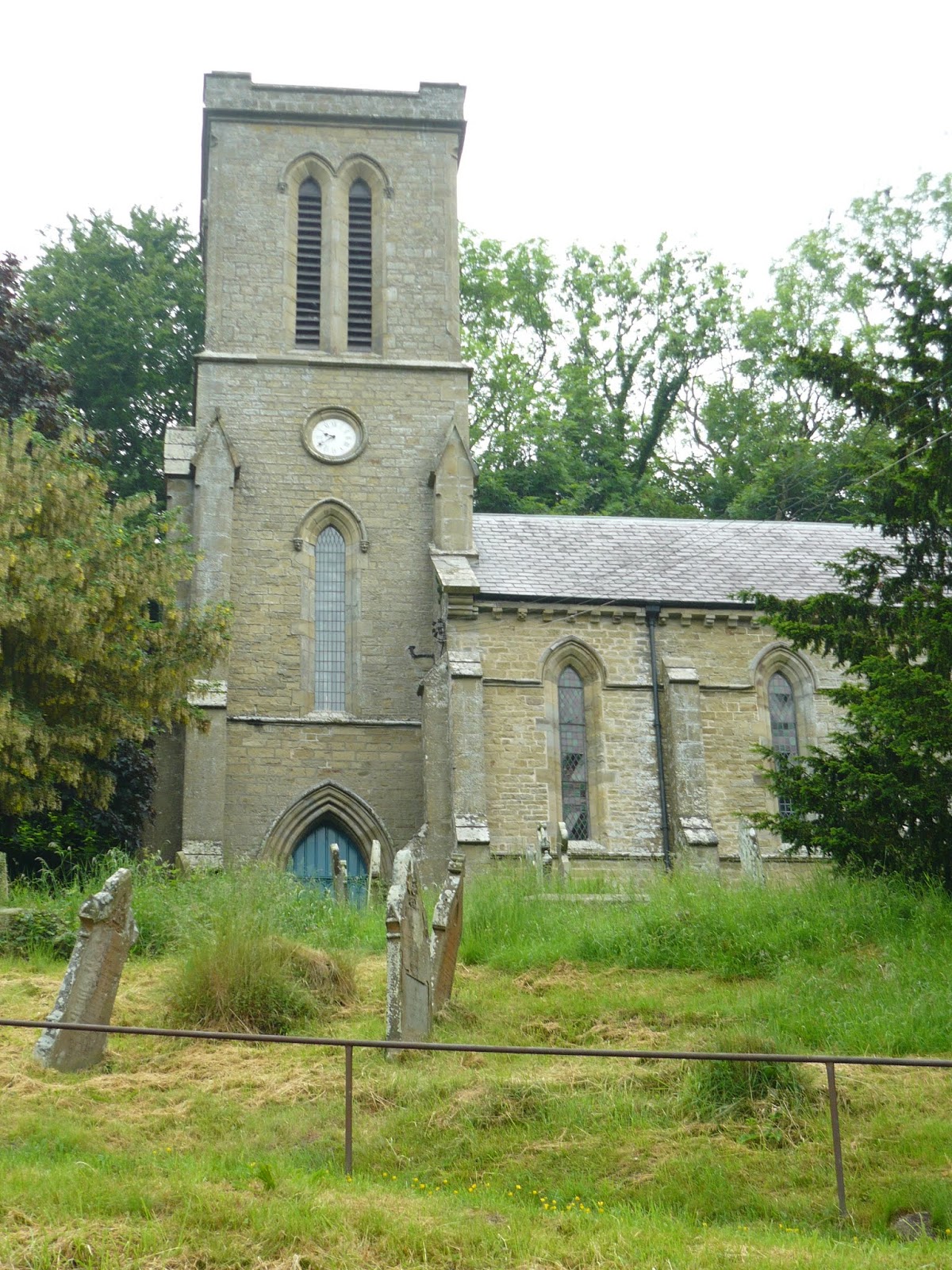
 St Mary's Church in New Radnor looks rather forlorn - I wonder how large the current congregation is as it doesn't look very used. Still, it's kept open for visitors and that's a good thing.
Great Aunt Ethel's grave is quite a long way from the church itself but a rose has been planted on it and it does look cared for. Her will has given me some clues as to other relatives as she bequeathed sums to three sets of great nieces and nephews. Robert Jones and John Jones (who I believe to be the sons of her brother Walter Jones, the younger brother of my grandfather Pryce), Bryan Thomas and Janet Thomas (the son and daughter of Florence Mantle - the daughter of Edward Davies Mantle, the child of my great great grandmother, Eliza Rees - I'm not exactly sure of the relationship here but Edward Davies Mantle was the half brother of Sarah Mantle Lewis) and Mervyn Hart and Christine Hart (I've yet to work out the relationship for this set).

So, having paid my respects to Great Aunt Ethel I continued my journey; through Leominster and off towards Ludlow to stop at Berrington Hall, a National Trust property. I thoroughly enjoyed this stop; the house is unprepossessing on the outside but well proportioned on the inside.
There was a fascinating 'event' taking place: https://www.nationaltrust.org.uk/berrington-hall/features/a-dress-with-a-tale . In brief, an 18th century dress belonging to the mistress of Berrington had been found at auction and it was being studied and preserved when I visited. The conservator was on the premises and came to talk to a few us visitors about the dress and how it had been made, the material etc etc. It was fascinating - silk fabric (probably produced in Spitalfields) with gold thread (not silver gilt and so still as bright as when it was made). They hope to preserve the original and make a plain duplicate to have more understanding of how court mantuas were made and worn.
I ended the day at Hinckley, Leicestershire. Onward to Bosworth Field tomorrow!
Why New Radnor? Well, I've been aware that Sarah Mantle Lewis, my great grandmother, while she lived in Llandewi Ystradenny, had an illegitimate child, Ethel. Ethel's birth certifcate doesn't name the father but the birth took place at the Smith Shop where Richard Jones was the blacksmith. Known alternatively as Ethel Lewis and later, Ethel Jones, she spent much of her life 'in service'. As I knew her birth date, I was able to find her in the 1939 Register in New Radnor. I've also obtained a copy of her will. I'd checked the MIs for New Radnor at Powys Archives and so I was able to 'visit'.
Great Aunt Ethel's grave is quite a long way from the church itself but a rose has been planted on it and it does look cared for. Her will has given me some clues as to other relatives as she bequeathed sums to three sets of great nieces and nephews. Robert Jones and John Jones (who I believe to be the sons of her brother Walter Jones, the younger brother of my grandfather Pryce), Bryan Thomas and Janet Thomas (the son and daughter of Florence Mantle - the daughter of Edward Davies Mantle, the child of my great great grandmother, Eliza Rees - I'm not exactly sure of the relationship here but Edward Davies Mantle was the half brother of Sarah Mantle Lewis) and Mervyn Hart and Christine Hart (I've yet to work out the relationship for this set).

So, having paid my respects to Great Aunt Ethel I continued my journey; through Leominster and off towards Ludlow to stop at Berrington Hall, a National Trust property. I thoroughly enjoyed this stop; the house is unprepossessing on the outside but well proportioned on the inside.
There was a fascinating 'event' taking place: https://www.nationaltrust.org.uk/berrington-hall/features/a-dress-with-a-tale . In brief, an 18th century dress belonging to the mistress of Berrington had been found at auction and it was being studied and preserved when I visited. The conservator was on the premises and came to talk to a few us visitors about the dress and how it had been made, the material etc etc. It was fascinating - silk fabric (probably produced in Spitalfields) with gold thread (not silver gilt and so still as bright as when it was made). They hope to preserve the original and make a plain duplicate to have more understanding of how court mantuas were made and worn.
I ended the day at Hinckley, Leicestershire. Onward to Bosworth Field tomorrow!

Research Trip 2018 (5)
The morning was set aside to visit a friend (from my days as the non-residential administrator at St Michael's Theological College,Cardiff) in Newbridge-on-Wye but I managed to drop into a church on the way! This time it was St Gwrthwl's, Llanwrthwl - where 3x great grandfather, James Price was baptised on 10 Sept 1786.
I think this has to be my favourite church of the ones I've visited on this trip. The church gate is incredibly stiff and I couldn't open it from the outside. Fortunately, there are steps!

It's a little more precarious on the downward side! I loved the interior of this church; it's carpeted throughout and I was particularly taken with the natural stone of the west end wall.

Tucked away down there are tea and coffee making facilities for the many walkers that pass through the village. Judging by the comment in the visitors' book, it's much appreciated. I did manage to push open the gate from the church side which saved climbing back over the wall!
Onto Powys Archives which is now located on the Ddole Road Industrial Estate; purpose built facilities for the preservation of the archives. Could I find it? I knew it was Unit 29 but the road markings leave a lot to be desired. The sign that read 'Units 23 and upward' was badly worn and impossible to read from the road. Anyway, I found it eventually and was made welcome.
I confined myself mainly to the parish records that aren't available on findmypast; Llanbister and Llananno which are available as scanned copies (so no having to struggle with microfilm!) in the office. I've verified some baptisms for the Woodside, Llananno Joneses and some Reeses and realised I had driven past Great Meadows, the address given for Sarah Mantle and Richard Benbo (for the baptism of Richard, Sarah and John Benbo in 1867 although this is awkward because Richard Benbo married Adeliza Mantle and died in 1862!) on the mini-adventure!
I've also gleaned more information from the records for Llanbadarn Fynydd for the family of great uncle James Jones which brings me a bit more up-to-date with them.
I think the most interesting things on this visit were the Memorial Inscriptions and we have to be grateful to volunteers who record the position of, and details on, headstones in church yards.
Firstly, I decided to check the details for 3x great grandfather, Edward Thomas. Born in Welshpool in 1808, Edward lived to the ripe old age of 93, dying in 1903 in Newtown. I'd seen his burial record in the parish register some years before. It's really interesting as the minister had noted, in the margin: "used to tell everybody in his latter days that he had committed a 'great crime'. When asked what the event was, he would reply, 'too old to work' ".
I knew he had a headstone at St David's Church, Newtown but had never found it so I wanted to re-check the details. Here's what is noted: "337 - composite headstone with slate plaque and urn. Urn: In memory of M Morris from friends and neighbours. Headstone: In loving memory of Edward Thomas, aged 93 years. Buried 22 Jan 1903. Also of Margaret Morris, granddaughter of the above. Died 30 Oct 1946 aged 67. "Fell from a railway compartment at Forden Station on to the rails and received severe injuries which proved fatal. Rest in Peace".
I'd seen an entry for a Margaret Morris of about the right age in the 1939 Register at the Public Assistance Institution at Forden; a member of staff who was a seamstress and wondered whether it could be her. I would need to order a death certificate to confirm but it seemed very likely now.
I also found out something else but I'm going to leave that until tomorrow...
I think this has to be my favourite church of the ones I've visited on this trip. The church gate is incredibly stiff and I couldn't open it from the outside. Fortunately, there are steps!

It's a little more precarious on the downward side! I loved the interior of this church; it's carpeted throughout and I was particularly taken with the natural stone of the west end wall.

Tucked away down there are tea and coffee making facilities for the many walkers that pass through the village. Judging by the comment in the visitors' book, it's much appreciated. I did manage to push open the gate from the church side which saved climbing back over the wall!
Onto Powys Archives which is now located on the Ddole Road Industrial Estate; purpose built facilities for the preservation of the archives. Could I find it? I knew it was Unit 29 but the road markings leave a lot to be desired. The sign that read 'Units 23 and upward' was badly worn and impossible to read from the road. Anyway, I found it eventually and was made welcome.
I confined myself mainly to the parish records that aren't available on findmypast; Llanbister and Llananno which are available as scanned copies (so no having to struggle with microfilm!) in the office. I've verified some baptisms for the Woodside, Llananno Joneses and some Reeses and realised I had driven past Great Meadows, the address given for Sarah Mantle and Richard Benbo (for the baptism of Richard, Sarah and John Benbo in 1867 although this is awkward because Richard Benbo married Adeliza Mantle and died in 1862!) on the mini-adventure!
I've also gleaned more information from the records for Llanbadarn Fynydd for the family of great uncle James Jones which brings me a bit more up-to-date with them.
I think the most interesting things on this visit were the Memorial Inscriptions and we have to be grateful to volunteers who record the position of, and details on, headstones in church yards.
Firstly, I decided to check the details for 3x great grandfather, Edward Thomas. Born in Welshpool in 1808, Edward lived to the ripe old age of 93, dying in 1903 in Newtown. I'd seen his burial record in the parish register some years before. It's really interesting as the minister had noted, in the margin: "used to tell everybody in his latter days that he had committed a 'great crime'. When asked what the event was, he would reply, 'too old to work' ".
I knew he had a headstone at St David's Church, Newtown but had never found it so I wanted to re-check the details. Here's what is noted: "337 - composite headstone with slate plaque and urn. Urn: In memory of M Morris from friends and neighbours. Headstone: In loving memory of Edward Thomas, aged 93 years. Buried 22 Jan 1903. Also of Margaret Morris, granddaughter of the above. Died 30 Oct 1946 aged 67. "Fell from a railway compartment at Forden Station on to the rails and received severe injuries which proved fatal. Rest in Peace".
I'd seen an entry for a Margaret Morris of about the right age in the 1939 Register at the Public Assistance Institution at Forden; a member of staff who was a seamstress and wondered whether it could be her. I would need to order a death certificate to confirm but it seemed very likely now.
I also found out something else but I'm going to leave that until tomorrow...
Friday, 8 June 2018
Research Trip 2018 (4)
Today I had planned to visit Newtown's (in Powys) Textile Museum as I'd never been before and many of my family were involved in various aspects of the trade: woolsorter, wool stapler, hand loom weaver, weaver, tailoress etc. I thought I had correctly noted the opening days but no - I got there and it was closed. Ho hum - another visit in the future?
All was not lost as, on another glorious day, I had dropped into the churches in the villages along the A483 where family members had lived in years gone by.
I started at Llanbister where my grandfather, Pryce Jones was born in 1899; I've been to Llanbister before and taken pictures of the war memorial where Pryce's elder brother, Thomas Jones is commemorated. He died in France in 1917 and has no known grave so is commemorated at Tyne Cot. I've tried to get into the church before and found it locked (or so I thought) but on this day, being rather blessed, I arrived about the same time as the curate (who explained that the church is usually open but the door is particularly stiff). It's a huge church (the cathedral of the Ithon Valley), has steps up to the front door, steps to the main body of the church, steps up to the altar. It also, most unusually, has a baptistry!
On to Llananno, the parish church for the Joneses when they were the blacksmiths at Woodside, which has the most beautiful rood screen (most of these were destroyed at the Reformation)

Llananno is set very close to the Ithon River which you can hear as you approach ther church - a welcome change to the noise of the A483!
The next parish church is Llanbadarn Fynyddd where Richard and Eliza Mantle are buried (the headstone is right next to the church entrance) as well as Richard Jones and his first wife, Mary Crowther.
On the long drop down into Newtown, I stopped off at St Paul's Church, Dolfor to take a photo of the church there - sadly, it wasn't open so I've yet to see inside. The smithy, where Timothy Jones was the smith and where his widow, Hannah married the next smith, James Mills is just opposite the church. James and Hannah are buried here (Timothy is buried at Llandinam for reasons I have yet to discover).
On the way back to Rhayader, I decided I'd have a mini-adventure and take the back road to Abbey Cwmhir. This was the birthplace f 3x great granny Sarah Richards who married the Richard Mantle born in 1787 (much like the Joneses, the Mantles favoured the name Richard and there are several of them). Adventure it was! It's pretty much a single tracked road with few passing places. Indeed at one point I had to reverse a long way to find room for a tractor to pass.
The church at Abbey Cwmhir was much embellished by the local landowners, the Phillips family; a little too much for my taste

Back to Rhayader and just enough time to work out what I should be looking at when I visit Powys Archives in Llandrindod Wells tomorrow.
All was not lost as, on another glorious day, I had dropped into the churches in the villages along the A483 where family members had lived in years gone by.
I started at Llanbister where my grandfather, Pryce Jones was born in 1899; I've been to Llanbister before and taken pictures of the war memorial where Pryce's elder brother, Thomas Jones is commemorated. He died in France in 1917 and has no known grave so is commemorated at Tyne Cot. I've tried to get into the church before and found it locked (or so I thought) but on this day, being rather blessed, I arrived about the same time as the curate (who explained that the church is usually open but the door is particularly stiff). It's a huge church (the cathedral of the Ithon Valley), has steps up to the front door, steps to the main body of the church, steps up to the altar. It also, most unusually, has a baptistry!
On to Llananno, the parish church for the Joneses when they were the blacksmiths at Woodside, which has the most beautiful rood screen (most of these were destroyed at the Reformation)

Llananno is set very close to the Ithon River which you can hear as you approach ther church - a welcome change to the noise of the A483!
The next parish church is Llanbadarn Fynyddd where Richard and Eliza Mantle are buried (the headstone is right next to the church entrance) as well as Richard Jones and his first wife, Mary Crowther.
On the long drop down into Newtown, I stopped off at St Paul's Church, Dolfor to take a photo of the church there - sadly, it wasn't open so I've yet to see inside. The smithy, where Timothy Jones was the smith and where his widow, Hannah married the next smith, James Mills is just opposite the church. James and Hannah are buried here (Timothy is buried at Llandinam for reasons I have yet to discover).
On the way back to Rhayader, I decided I'd have a mini-adventure and take the back road to Abbey Cwmhir. This was the birthplace f 3x great granny Sarah Richards who married the Richard Mantle born in 1787 (much like the Joneses, the Mantles favoured the name Richard and there are several of them). Adventure it was! It's pretty much a single tracked road with few passing places. Indeed at one point I had to reverse a long way to find room for a tractor to pass.
The church at Abbey Cwmhir was much embellished by the local landowners, the Phillips family; a little too much for my taste

Back to Rhayader and just enough time to work out what I should be looking at when I visit Powys Archives in Llandrindod Wells tomorrow.
Tuesday, 5 June 2018
Research Trip 2018 (3)
Today was a dedicated shopping day with a trip over to West Wales and Carmarthen but I was able to return to Rhayader via a small place called Llys-Wen between Brecon and Builth Wells. As I arrived there, I realised I had been here before; always travelling through but never stopping.
I wanted to call in here to see if I could find any confirmations about David Jones, my great great uncle and son of Richard (the first) Jones. The David Jones who lived at Llys-Wen married Louisa Newman, the postmistress in 1879. I'm presuming this is 'my' David as his profession is given as blacksmith and his father's name is given as Richard Jones, profession, blacksmith. On subsequent censuses he gives his place of birth as Llananno which also helps to confirm my thinking.
My only misgivings are that later a second christian name appears- Timothy - although this is this paternal grandfather's name. Looking him up on findmypast led to reports in the Western Mail on 23 June 1915: Mr David Jones, Llyswen Breconshire, was found drowned in the River Wye early on Tuesday morning. He went to the river to bathe on the previous evening. The deceased was the village postman and smith and had lived in Llyswen over 40 years. He was 60 years.
On 24 June 1915: An inquiry was held in the parish hall. Miss Ophelia Jones, daughter, said that when he left the house Monday evening he told her he was going to the river to bathe. The jury returned a verdict of accidental death.
Two years later, tragedy again hit the family when David and Louisa's son, John Jones, serving with 11th Battalion South Wales Borderers was killed in action in France on 31 July 1917. He's commemorated on a panel at the Menin Gate, Ypres and the memorial in St Gwendoline's Church in Llys-wen.


I wanted to call in here to see if I could find any confirmations about David Jones, my great great uncle and son of Richard (the first) Jones. The David Jones who lived at Llys-Wen married Louisa Newman, the postmistress in 1879. I'm presuming this is 'my' David as his profession is given as blacksmith and his father's name is given as Richard Jones, profession, blacksmith. On subsequent censuses he gives his place of birth as Llananno which also helps to confirm my thinking.
My only misgivings are that later a second christian name appears- Timothy - although this is this paternal grandfather's name. Looking him up on findmypast led to reports in the Western Mail on 23 June 1915: Mr David Jones, Llyswen Breconshire, was found drowned in the River Wye early on Tuesday morning. He went to the river to bathe on the previous evening. The deceased was the village postman and smith and had lived in Llyswen over 40 years. He was 60 years.
On 24 June 1915: An inquiry was held in the parish hall. Miss Ophelia Jones, daughter, said that when he left the house Monday evening he told her he was going to the river to bathe. The jury returned a verdict of accidental death.
Two years later, tragedy again hit the family when David and Louisa's son, John Jones, serving with 11th Battalion South Wales Borderers was killed in action in France on 31 July 1917. He's commemorated on a panel at the Menin Gate, Ypres and the memorial in St Gwendoline's Church in Llys-wen.


Monday, 4 June 2018
Research Trip 2018 (2)
Today I headed to Powis Castle (I've just got a National Trust membership so why not?) across rural Wales which brought me up short a couple of times - hills, sharp corners, in and out of tiny market towns - quite an adventure especially as I'm both driving and navigating.
Anyway, first up was a stop at Nantmel. St Cynllo's , Nanmel is where my 4x great grandparents, Richard Evans and Mary Francis were married on 14 April 1800. I had hopes of maybe seeing a headstone in the churchyard with some family names but although there were several from that era, none were particularly legible.

The interior of the church was rather odd - while the church remains open (and that's a great thing) I couldn't get the lights to go on so it all seemed rather gloomy and didn't really match the exterior - see what you think:

On to Powis Castle via Forden where my 3 x great grandfather, John Morris was. born in the 'House of Industry' (workhouse, in other words) in 1821. Sadly, I didn't see the workhouse building; this was due to not doing my homework properly and checking where the building was actually located.
I'd last visited Powis Castle in the 1960s/1970s so this was a welcome re-visit. As with most National Trust Houses, the interiors are kept gloomy (curtains closed, blinds drawn) to preserve artifacts and materials. While this is understandable, it doesn't really give the visitor an accurate idea of what it was like to live there.
The gardens, however, are a joy. I could upload a plethora of pictures but perhaps just one will suffice for now

Shopping trip tomorrow but maybe there'll be a family history sightseeing opportunity on the way 'home'....
Anyway, first up was a stop at Nantmel. St Cynllo's , Nanmel is where my 4x great grandparents, Richard Evans and Mary Francis were married on 14 April 1800. I had hopes of maybe seeing a headstone in the churchyard with some family names but although there were several from that era, none were particularly legible.

The interior of the church was rather odd - while the church remains open (and that's a great thing) I couldn't get the lights to go on so it all seemed rather gloomy and didn't really match the exterior - see what you think:

On to Powis Castle via Forden where my 3 x great grandfather, John Morris was. born in the 'House of Industry' (workhouse, in other words) in 1821. Sadly, I didn't see the workhouse building; this was due to not doing my homework properly and checking where the building was actually located.
I'd last visited Powis Castle in the 1960s/1970s so this was a welcome re-visit. As with most National Trust Houses, the interiors are kept gloomy (curtains closed, blinds drawn) to preserve artifacts and materials. While this is understandable, it doesn't really give the visitor an accurate idea of what it was like to live there.
The gardens, however, are a joy. I could upload a plethora of pictures but perhaps just one will suffice for now

Shopping trip tomorrow but maybe there'll be a family history sightseeing opportunity on the way 'home'....
Sunday, 3 June 2018
Research Trip 2018 (1)
So, now that I have retired, I have decided that I should have some research trips to further my researches. This first year, I have focussed on mid-Wales as the release of the 1939 Register in the UK has meant I've gained lots of extra information on both sides of the family.
This week, I am in Rhayader, Powys - it's more or less central to the places I wish to visit; Newtown, Llandrindod Wells (location of Powys Archives), Llanbadarn Fynydd and so on. Since today is Sunday, I've been to church (St Clement's, Rhayader) and it's been a pleasure for me to take communion with the Church in Wales again after a break of about 3 years. The congregation was welcoming and interested to hear that I was on a family history research trip. After the service, I couldn't resist a mooch around the churchyard and was rewarded (I hope) to discover a headstone for Richard Oliver Jones, blacksmith. I think this is a son of James Jones (my great uncle who was the blacksmith at Llanbadarn Fynydd). I'll have to order a marriage certificate to confirm (or not) the details, of course.
In the afternoon, I travelled over to Llanllwchaiarn, hoping that the church may be open - sadly not, but I did have a look around the churchyard again. I presume that quite a few of my forebears are buried here but either they haven't had headstones or they've long been overgrown and/or deteriorated.

For example, I understand that my grandmother, Ethel (Morris) Jones is buried in a common grave in front of the headstone here. Born in Newtown, she died in Nuneaton, Warwickshire in 1927 after the birth of my Dad's younger brother. It's sad that a) she's buried in a common grave and b) that there's no marker. I shall have to look into what can be done to rectify this.
While in Newtown (Llanllwchaiarn is essentially a part on Newtown these days, although a different parish) I went to the municipal cemetery. I have never been here before, despite having made several trips, so didn't know what to expect. I shall have to look at the Memorial Inscriptions held at Powys Archives (which I have booked to visit on Wednesday) so see if I need to make another visit before I go home.
All in all, it's been a good day - the weather has been glorious and this is a lovely part of the world. Here's a picture of the view from my bedroom window in Rhayader:
 More tomorrow
This week, I am in Rhayader, Powys - it's more or less central to the places I wish to visit; Newtown, Llandrindod Wells (location of Powys Archives), Llanbadarn Fynydd and so on. Since today is Sunday, I've been to church (St Clement's, Rhayader) and it's been a pleasure for me to take communion with the Church in Wales again after a break of about 3 years. The congregation was welcoming and interested to hear that I was on a family history research trip. After the service, I couldn't resist a mooch around the churchyard and was rewarded (I hope) to discover a headstone for Richard Oliver Jones, blacksmith. I think this is a son of James Jones (my great uncle who was the blacksmith at Llanbadarn Fynydd). I'll have to order a marriage certificate to confirm (or not) the details, of course.
In the afternoon, I travelled over to Llanllwchaiarn, hoping that the church may be open - sadly not, but I did have a look around the churchyard again. I presume that quite a few of my forebears are buried here but either they haven't had headstones or they've long been overgrown and/or deteriorated.

For example, I understand that my grandmother, Ethel (Morris) Jones is buried in a common grave in front of the headstone here. Born in Newtown, she died in Nuneaton, Warwickshire in 1927 after the birth of my Dad's younger brother. It's sad that a) she's buried in a common grave and b) that there's no marker. I shall have to look into what can be done to rectify this.
While in Newtown (Llanllwchaiarn is essentially a part on Newtown these days, although a different parish) I went to the municipal cemetery. I have never been here before, despite having made several trips, so didn't know what to expect. I shall have to look at the Memorial Inscriptions held at Powys Archives (which I have booked to visit on Wednesday) so see if I need to make another visit before I go home.
All in all, it's been a good day - the weather has been glorious and this is a lovely part of the world. Here's a picture of the view from my bedroom window in Rhayader:

Monday, 12 December 2016
Jeremiah Owen - a long life
In 2005 I sent for the death certificate of who I thought was my 4th great grandfather, Jeremiah Owen(s) but it wasn't clear that it was the right one - the certificate said that he had died after an accident and that an inquest had been held but I hadn't been able to find evidence to back that up. Checking up recently on Findmypast, I found the following from the Shrewsbury Chronicle of 22 Nov 1862 - it's his granddaughter's evidence that clinches it:
Fatal accident: On Saturday last,
an inquest was held at the Bear Hotel, before Dr. Slyman, coroner, and a
respectable jury, to inquire into the cause of the death of Jeremiah Owen, an
old man, residing in the Pool Road, who had met with his death under
circumstances which will be gathered from the following evidence.
Mr. W Baird said: I am
Chief-constable of the county of Montgomery. Deceased had been in my employ for
seventeen years. He was in his ninety-first year, and latterly he has been
rather more frail than usual. No man could be more honest and straight forward
than he was. On Sunday he was in his usual good health. I saw him on the street
on Tuesday morning, but did not speak to him.
Harriet Jones said: the deceased
was my grandfather. He lodged with my mother. He rose on Tuesday morning about
eleven or twelve o’clock and had his breakfast as usual. He dressed himself to
go to a funeral at the New Inn about one o’clock on that day. When he returned home
about five o’clock he said he had had a very foul fall, and cut his eye-brow,
and Mr. Hall had sewn it up. He went to bed without complaining much. Next day,
he did not rise. His eye was much swollen, and he was very ill. Mr. Hall saw
him on Wednesday morning. Finding he was not the club doctor, my mother sent
for Mr. Owen, who is the club doctor. On
Thursday night he was very restless. I was up with him every night. He died on
Friday afternoon at four o’clock.
John Evans said: I am one of the
stewards of the Newtown Friendly United Society. The late Jeremiah Owen was a
member of that society. He had been a member about thirty-five years. A rule of
the club is to invite twenty-two members of the club, with two stewards, to
attend the funerals of deceased members. Jeremiah Owen was one who was selected
to attend the funeral of the late Richard Davies to the parish church of
Llanllwchaiarn. I attended the funeral. The members started from the new Inn.
They were all orderly and soberly. The allowance of drink is a pint for each
man and deceased did not have more than a pint. I cannot say he was not the
worse for liquor. I should say he was not drunk. He did not go further than the
pump, next to the National Schools, near Severn side wall. There were several
slides there, and they were dangerous. As I was appointing four to carry the
coffin, the deceased fell just opposite the pump. He fell on one of the slides,
in the middle of the road, which had been made by children. I and another
steward assisted him up, and took him to Mr. Hall’s surgery. Mr. Hall dressed
the wound which he had received in his fall. The wound was on the left eye, and
he had a cut upon his cheek. I left the deceased at Mr. Hall’s surgery and did
not see him afterwards.
Mr. Hall said: I am a surgeon
residing in Newtown. I saw the deceased on the day of the accident at my
surgery. I should think it was about four o’clock in the afternoon. He had a
lacerated wound above the left eye, dividing the soft parts quite to the bone,
of about two inches in extent. There was a slight bruise also upon the left
cheek. I dressed the wound, and after having asked him whether he was capable
of walking home, he left my surgery with that intention. I saw him next on
Wednesday morning about ten o’clock when he appeared abut as well as I could
expect. I directed his daughter to send for Mr. Jones, who was the medical
officer of the district in which he resided. I saw him again on Thursday night,
at the request of Mr. Baird, when he appeared feeble and rather drowsy, but he
knew me, and answered my questions correctly. I did not give him any medicine,
because I was informed that he had taken some from Mr. Owen. He appeared quite
sober when he came to my surgery. I don’t think he had suffered much from loss
of blood occasioned by the wound. My opinion is that he died from the combined
effects of congestion of the brain and exhaustion, consequent upon injury to
the head.
Mr. J. Owen said: I am engaged to
attend the sick members of the Newtown Friendly United Society. I have attended
the members about three years last July. I don’t know whether my name appears
or not in the list of the Medical registers.
The Coroner then said he could
not therefore receive any medical evidence from Mr. Owen. The Coroner then
called Mr. Evans, the steward of the club, and told him that a recent Act of
Parliament required that all medical practitioners should have their names
registered on an authorised medical list. Mr. Owen, by practising, not having
complied with this, rendered himself liable to a penalty; but the effect upon
those who employed unregistered medical practitioners was, that no fees could
be legally claimed from them by these practitioners. It was much to be
regretted that a public body did not employ properly authorised medical men,
and that they did not offer to pay them a sum which was worthy of their
receiving; the labourer was worthy of his hire, and the contemptible small sums
which were offered to medical men by these clubs was disgraceful. He then
addressed the jury, and in referring to the cause of the death of the deceased,
said, there was no doubt was traceable to the fall upon the slides. Those
slides were made in the middle of the road by boys, who indulged in this
dangerous and mischievous practice with impunity, and which he was sorry to say
they were encouraged by their parents. He hoped an example might be made of
some of them as that might have the effect of preventing its repetition. Mr.
Hall had seen the deceased at first, immediately after the accident, and it
would have been better in his opinion if Mr. Hall had continued his attendance;
as it was the poor man seemed to have had both too little and too much medical
advice. He was sorry that he was obliged to speak of Mr. Owen’s interference in
the way he had, but it was his duty to do so, and he was anxious to take every
public opportunity of protesting against the interference of unauthorised
medical practitioners.
A verdict of ‘Accidental death’
was then returned.
Wednesday, 30 December 2015
Martha Fair Tweddle (Stratford)
 |
| Martha Tweddle |
Martha married John Tweddle (a solicitor) on 14 August 1840 at Bishopwearmouth by licence - Martha was still a minor. And an orphaned minor at that - the marriage bond was signed by a Robert Fair.
I found her in the 1840 census in the household of William and Mary Laing (grocer) in New Elvet Durham. John Tweddell, in 1841 was in Durham Gaol and House of Correction - a prisoner. I had wondered whether that was some sort of mistake - he was an attorney after all - but no, other cousins have done much research and found evidence that although he was a solicitor, Tweddell was also a crook.
Their first two children, Anne and George were born in London, daughter Mary back in Stockton and a son, John was born in 1850 (about whom I currently have no further details. Martha doesn't show up anywhere in the 1851 census but whether that's due to mistranscriptions or evasion, none of us are sure. John Tweddell is living in York Street in Stockton with his daughter, Mary aged 4. The other children are living with their Tweddle grandparents. We have no trace of John after this.
And what of Martha?
My great grandmother, Hannah was born on 27 March 1854 in Drypool, Hull. The father was named as Bryan Stratford (occupation, millwright), the mother, Martha Stratford, formerly Fair.
Margaret was born in Houghton-le-Spring in March 1857, Sarah in Stockton in 1860 and William, also in Stockton in 1862.
For some reason, in 1861, the family was in Leeds, boarding in Brick Street with a family called O'Reilly. Perhaps at this point, Bryan was still working (Bryan will have an entry of his own, later when all will become clear).
In 1871, Bryan is living in lodgings in Housewife Lane, Stockton; Martha and the 4 children (and 2 Welsh puddler lodgers) are in York Street, Thornaby
In 1881, Bryan is in the Stockton Workhouse; Martha, now styling herself 'solicitor's widow' is in Queen Street East, Thornaby with her son, William and a niece, Elizabeth Westerman.
In 1891, Martha is in Hutchinson Street, living on her own means and sharing the house with a Welsh family.
Martha died on 11 October 1899 at 29 Hind Street, Stockton (was this her own address?) and her occupation is listed as Widow of John Tweddell, Solicitor. At 76, her cause of death was 'Old Age. Congestion of lungs'. The informant was Sarah Bailey, daughter, present at the death.
I just want to go back to the children she had by John Tweddle; Anne married William Hogg in 1888 but died in Sedgefield Asylum of 'mania' in 1919; William died in an accident at Shildon Works in 1861.
Mary married Richard Brown Hall in 1868; Richard was the son of George Hall and my great, great aunt, Jane Brown who married in June 1842. Strange when two branches of the family come together! George (a grocer) died of typhus in October 1843, Jane, of dropsy, in 1853. Mary died in 1882 (aged 36) of phthisis (we know this as TB nowadays), Richard in 1900 of renal disease and cardiac disease.
Monday, 28 December 2015
Mary Jane Agar
I've been able to follow Mary Jane Agar a little further. Mary Jane was also known as Polly. There's a whole blog in the offing about names people are known by...why on earth are women called Mary Jane known as Polly?, how does Margaret become Peggy?, Henry become Harry? etc etc
Anyway, knowing that my Gran, Stella was fond of her Aunt Polly (Mary Jane Agar) leads me to think that she must have met up with her at some point and Gran lived in Hartlepool.
As we know, Polly was 'in service' and at one time was in the household of the son of Titus Salt but I've 'lost' her in between the 1891 census and her death in 1926. I'm not sure why I thought to look for a death in Hartlepool but http://www.durhamrecordsonline.com/ might have helped but I do have a death certificate now.
From thinking a couple of years ago that she might have been pretty much on her own, being an illegitimate child, it cheered me very much to see that when she died, she was living in the household of her half sister Hannah (of whom, much more to come) in Hartlepool and her death was reported by her half brother, Robert.
The death certificate lists her occupation as: Spinster. Daughter of Elizabeth Agar, the widow of Robert Stonehouse, Innkeeper (deceased). The informant was Robert Stonehouse, halfbrother, In Attendance. She wasn't alone.
I didn't know any of this until I bought the death certificate. How much other family history have I missed?
Saturday, 26 December 2015
It's been how long?
Well, nearly two years! So much has happened, I moved back to England -I now live in Long Eaton, Derbyshire and work at Nottingham Trent University in Nottingham and there are even family links here!
Soon, I'm going to catch up with a few of the personalities I've already mentioned where new information has come to light and introduce you to a few others - some whole new branches of the family tree.
I'm going to look at some themes; shopkeepers, musicians, sportsmen, railwaymen, clergymen, a couple of mysteries (brickwalls), some international connections and maybe some Armed Forces stories (although that might be a whole new Blog).
Soon, I'm going to catch up with a few of the personalities I've already mentioned where new information has come to light and introduce you to a few others - some whole new branches of the family tree.
I'm going to look at some themes; shopkeepers, musicians, sportsmen, railwaymen, clergymen, a couple of mysteries (brickwalls), some international connections and maybe some Armed Forces stories (although that might be a whole new Blog).
Friday, 18 October 2013
Burdett Lambton Brown
Burdett was baptised in Washington, Co Durham in November of 1820 and first appears in the census of 1841 living in the household of his brother (or so it appears due to the ages given) George, possibly George's wife, Catherine and their son, Anthony - relationships are given in the 1841 census. George is a smith (like their father Ralph) and Burdett is an engineer. Why Burdett? It's a tradition in that part of the north east for some families to 'protect' surnames by using them as given names and I suspect that is the case here.
Burdett married Ann Morgan in 1844; she was the daughter of an engine driver. They had two children, Jane and Hannah but Ann died in 1849. By this time, the family was in Chepstow, Monmouthshire. Burdett returned to the north-east of England to marry his second wife, my great, great aunt, Elizabeth Mary Brown.
I suspect these two are cousins, because of the coincidences elsewhere in the family of the surnames they used for given names for their children, but I need to do more research on this.
Their fist child was Ralph Lambton Brown, then Lizzie Sarah, Mary Oughton Brown, George P(hilip?) and Thomas Lumsden Brown (not to be confused with my great great grandfather of the same name, Elizabeth's youngest brother).Ralph and Lizzie were both born in Chepstow, Mary in Newport (also Monmouthshire), George in West Bromwich (Staffordshire, modern day West Midlands) and Tom in Wednesbury Staffs, now West Midlands). The family moved a lot with Burdett's profession.
Catching up with the family via censuses, in 1851 they were living in Chepstow and Burdett's profession is given as practical engineer. In 1861 in Wednesbury and Burdett is manager & engineer (but where is Ralph? At school somewhere?).
In December of 1861, John James Russell (as far as I know, no relation!) of the Crown Tube Works, Wednesbury in the county of Stafford, Patent Tube manufacturer and Burdett Lambton Brown of the same place, Engineer in the employ of the said JJR applied for, and were granted, a patent 'for an invention for improvements in apparatus used in the manufacture of taper tubes'. You can find more information about the Crown Tube Works at: http://www.historywebsite.co.uk/articles/Wednesbury/Tubes.htm
In 1871, at the same Church Hill address, Burdett is 'Wrought Iron Tube manufacturer employing 35 men and 16 boys'; Ralph has re-appeared an at the age of 19 is a wrought tube maker and they have a domestic servant. Their daughter, Mary, died later that year.
Lizzie Sarah married Samuel Hodgson in 1875, a clergyman and judging by later censuses and the birthplaces of their children, they travelled round a lot! I need to look him up in a Crockford's! I wonder if this relationship had an effect on Tom? Lizzie and Samuel's second child, William Hope Hodgson became an author and is now recognised as an important pioneer of 'modern imaginative fiction' (see: http://www.oxforddnb.com/index/56/101056875/ but you'll need a subscription)
George married Jane Jones in Wednesbury in 1879 and settled in nearby Walsall and became a bank clerk
By 1881 the remaining family had moved on again and were living in Hanover Square, Leeds; Burdett is an agent to a wrought iron tube depot and Ralph is a clerk to a wrought iron tube depot. Tom, who always seems to have been called Tom and not Thomas, was listed as being a theological student.
Burdett died in Leeds in February 1888 and Elizabeth and Ralph remained there sharing their home until at least 1911. In 1891, at the census they are joined briefly by a Mary Holwell, the sister of Amelia Holwell who had married Tom who by then had been ordained as an Anglican priest and was living in Monkwearmouth (and I do have his entry from Crockford's)
Ralph died in 1914 in Leeds; the informant of his death was Tom so I don't know if Elizabeth was still living at this point. I suppose that street directories will need to be consulted if I want to take this any further or maybe cemetery records but Elizabeth Brown is quite a common name especially in a city the size of Leeds.
A really interesting sideline that make family history so rewarding!
Burdett married Ann Morgan in 1844; she was the daughter of an engine driver. They had two children, Jane and Hannah but Ann died in 1849. By this time, the family was in Chepstow, Monmouthshire. Burdett returned to the north-east of England to marry his second wife, my great, great aunt, Elizabeth Mary Brown.
I suspect these two are cousins, because of the coincidences elsewhere in the family of the surnames they used for given names for their children, but I need to do more research on this.
Their fist child was Ralph Lambton Brown, then Lizzie Sarah, Mary Oughton Brown, George P(hilip?) and Thomas Lumsden Brown (not to be confused with my great great grandfather of the same name, Elizabeth's youngest brother).Ralph and Lizzie were both born in Chepstow, Mary in Newport (also Monmouthshire), George in West Bromwich (Staffordshire, modern day West Midlands) and Tom in Wednesbury Staffs, now West Midlands). The family moved a lot with Burdett's profession.
Catching up with the family via censuses, in 1851 they were living in Chepstow and Burdett's profession is given as practical engineer. In 1861 in Wednesbury and Burdett is manager & engineer (but where is Ralph? At school somewhere?).
In December of 1861, John James Russell (as far as I know, no relation!) of the Crown Tube Works, Wednesbury in the county of Stafford, Patent Tube manufacturer and Burdett Lambton Brown of the same place, Engineer in the employ of the said JJR applied for, and were granted, a patent 'for an invention for improvements in apparatus used in the manufacture of taper tubes'. You can find more information about the Crown Tube Works at: http://www.historywebsite.co.uk/articles/Wednesbury/Tubes.htm
In 1871, at the same Church Hill address, Burdett is 'Wrought Iron Tube manufacturer employing 35 men and 16 boys'; Ralph has re-appeared an at the age of 19 is a wrought tube maker and they have a domestic servant. Their daughter, Mary, died later that year.
Lizzie Sarah married Samuel Hodgson in 1875, a clergyman and judging by later censuses and the birthplaces of their children, they travelled round a lot! I need to look him up in a Crockford's! I wonder if this relationship had an effect on Tom? Lizzie and Samuel's second child, William Hope Hodgson became an author and is now recognised as an important pioneer of 'modern imaginative fiction' (see: http://www.oxforddnb.com/index/56/101056875/ but you'll need a subscription)
George married Jane Jones in Wednesbury in 1879 and settled in nearby Walsall and became a bank clerk
By 1881 the remaining family had moved on again and were living in Hanover Square, Leeds; Burdett is an agent to a wrought iron tube depot and Ralph is a clerk to a wrought iron tube depot. Tom, who always seems to have been called Tom and not Thomas, was listed as being a theological student.
Burdett died in Leeds in February 1888 and Elizabeth and Ralph remained there sharing their home until at least 1911. In 1891, at the census they are joined briefly by a Mary Holwell, the sister of Amelia Holwell who had married Tom who by then had been ordained as an Anglican priest and was living in Monkwearmouth (and I do have his entry from Crockford's)
Ralph died in 1914 in Leeds; the informant of his death was Tom so I don't know if Elizabeth was still living at this point. I suppose that street directories will need to be consulted if I want to take this any further or maybe cemetery records but Elizabeth Brown is quite a common name especially in a city the size of Leeds.
A really interesting sideline that make family history so rewarding!
Sunday, 5 May 2013
Finding Timothy
While making arrangements for Mum's funeral, I had to go into Cardiff City Library to access an attachment to an e-mail I'd received (it was PowerPoint which I can't currently open on my PC). Since I'd booked the computer for an hour, I thought I'd use the time to use 'findmypast.com' which I don't have a subscription for but you can access in most libraries. Findmypast and Ancestry have different resources so it's often a question of subscribing to one rather than both (at least for those of us on a budget)
Anyway, findmypast have Parish Burial Records and as a reader of this blog may remember, I've had trouble finding my ggg grandfather, Timothy Jones, the first of my blacksmithing Joneses. And there he was in the records for St Llonio, Llandinam (Montgomeryshire):
Timothy Jones, abode Kerry, buried 28 Jan 1824 aged 35
Which of course begs a few questions! Why was he buried in Llandinam when his abode was Kerry? Was he visiting Llandinam - there's a smithy there, was he working there? Did he die in Llandinam? Why didn't they take him home to Kerry?
One mystery solved, another takes its place
Anyway, findmypast have Parish Burial Records and as a reader of this blog may remember, I've had trouble finding my ggg grandfather, Timothy Jones, the first of my blacksmithing Joneses. And there he was in the records for St Llonio, Llandinam (Montgomeryshire):
Timothy Jones, abode Kerry, buried 28 Jan 1824 aged 35
Which of course begs a few questions! Why was he buried in Llandinam when his abode was Kerry? Was he visiting Llandinam - there's a smithy there, was he working there? Did he die in Llandinam? Why didn't they take him home to Kerry?
One mystery solved, another takes its place
Bereavement
I've been quiet for a while as I've come to terms with the loss of my Mum; she passed away on 22 March. At some point, I'll bring myself to complete her dates on Ancestry but in the meantime, it's rather nice to still see her as 'living'.
Hers was the death certificate I least wanted to receive and on my family tree - the basic one that just includes the blood line - I'm the only one left living. And oddly (or not, perhaps someone else can comment on this) since I've just written a new tree out to sit on the wall near my desk, the vast majority of that direct line died in the first half of the year (February, March and April are particularly bad months for Family Russell-Jones). Is that reversed in the southern hemisphere I wonder?
At least now there's a new opportunity to get the family headstone restored and updated; Mam's ashes are being interred with her parents (and there'll still be room for me when I'm gone) so we can make sure they're properly identified and commemorated.
Sad times.
Hers was the death certificate I least wanted to receive and on my family tree - the basic one that just includes the blood line - I'm the only one left living. And oddly (or not, perhaps someone else can comment on this) since I've just written a new tree out to sit on the wall near my desk, the vast majority of that direct line died in the first half of the year (February, March and April are particularly bad months for Family Russell-Jones). Is that reversed in the southern hemisphere I wonder?
At least now there's a new opportunity to get the family headstone restored and updated; Mam's ashes are being interred with her parents (and there'll still be room for me when I'm gone) so we can make sure they're properly identified and commemorated.
Sad times.
Wednesday, 13 March 2013
GRO Certificates
Every so often you need to confirm what you think you know and ordering a certificate from the General Register Office is a good means of doing so. It's not cheap - each certificate costs £9.25 these days but the system is easy and straightforward so it's often worth it. If you get the details right to start with!!
Today, the postman has delivered 3 certificates.
1. Death certificate for Frederick Woolley, my gg grandfather. Frederick died on 20th March 1913 at Bryn Street, Newtown (in the old county of Montgomeryshire). His occupation is given as house plumber and painter. The cause of death is given as 'Fatty degeneration of heart' & 'cardiac failure'. The informant is son Fred living in Cross Street, Newtown.
2. Death certificate of Eliza Woolley, the widow of Frederick who died 27 June 1922, again in Bryn Street. cause of death here is 'cerebral haemorrhage'.
Perhaps it's a bit morbid to order death certificates but they could prove useful to pick up on any recurring causes of death which we today ought to know about.
3. The third certificate is a marriage certificate; Luigi James Bellisario and Emma Lowe. I ordered this to check whether it was the same branch of Bellisarios as Gabriel in Cardiff and indeed it is. It looks as though Luigi James was born around 1865, but where? The 1881 census has him living in Cardiff but born in Italy and under the name of Bellmaris rather than Bellisario (a mistranscription error) so not always easy to follow.
Anyway, things to work on thanks to today's certificates
Today, the postman has delivered 3 certificates.
1. Death certificate for Frederick Woolley, my gg grandfather. Frederick died on 20th March 1913 at Bryn Street, Newtown (in the old county of Montgomeryshire). His occupation is given as house plumber and painter. The cause of death is given as 'Fatty degeneration of heart' & 'cardiac failure'. The informant is son Fred living in Cross Street, Newtown.
2. Death certificate of Eliza Woolley, the widow of Frederick who died 27 June 1922, again in Bryn Street. cause of death here is 'cerebral haemorrhage'.
Perhaps it's a bit morbid to order death certificates but they could prove useful to pick up on any recurring causes of death which we today ought to know about.
3. The third certificate is a marriage certificate; Luigi James Bellisario and Emma Lowe. I ordered this to check whether it was the same branch of Bellisarios as Gabriel in Cardiff and indeed it is. It looks as though Luigi James was born around 1865, but where? The 1881 census has him living in Cardiff but born in Italy and under the name of Bellmaris rather than Bellisario (a mistranscription error) so not always easy to follow.
Anyway, things to work on thanks to today's certificates
Tuesday, 12 March 2013
Coming soon....
I'm expecting certificates from the GRO (General Register Office) tomorrow; one marriage certificate and two death certificates which I intend to open as I blog....these may answer queries or open new cans of worms...oh how I love family history!!
Monday, 18 February 2013
Gabriel
I think Gabriel Bellisario was born in Rome around 1840; he first shows up in British records in 1859 when he married Mary Ann Agnes Hogan in Bristol; a son, Luigi Garibaldi Bellisario was born in 1860.
In 1861 he was recorded in the census in Sheffield (rented accommodation I think) with Mary Ann and Luigi; his profession being 'Professor of Music'. Young Luigi didn't last long, he died in 1861, Mary Ann died in 1870. At some point, Gabriel moved to Cardiff and by the 1871 census, he's in Chrichton Street Cardiff with 'wife' Amelia; his profession is now 'photographer'.
In 1871 Gabriel is living in Tudor Street (that's where I go now to catch a bus when the city centre is closed off for rugby internationals) although his photographic studio is 226 Bute Street (over a chemist shop) which sadly no longer exists.
Gabriel and Amelia married in Cardiff's registry office in April 1874. Gabriel's father is Luigi Bellisario, profession - author. Google hasn't produced anything to verify this, so if anyone knows anything different...
In 1881, everything changes, there's new information! Gabriel is head of the household with Amelia as his wife...but!! Here's also James, son aged 16, born Italy, profession 'embosser'; Joseph, son aged 14, born Bristol, mechanic and Ernesto, aged 2. Amelia's mother, Fanny Littleton is also part of the household and is described as 'paralytic'. Fanny died in 1885 and is buried in Cathay's cemetery in Cardiff.
James and Joseph - what happened to them? Do I look for James and Joseph or the Italian equivalents?
In 1891 we're still in Tudor Street (with the studio in Bute Street) but by 1901, Gabriel and Amelia had moved to Beauchamp St and Ernesto had moved out. In 1901, at the age of 23, Ernesto was in Liverpool and married to Frances Georgina Russell. Of which, more later)
In the 1911 census, Gabriel is listed as photographer and musician; I'm following up on local newspaper items where it looks as though he was playing the double bass at various concerts (how many signor Bellisarios were there in Cardiff anyway?)
Gabriel died in Cardiff on 26 Feb 1916 and is buried with his mother-in-law Fanny in Cathays cemetery (I was able to place flowers on their grave last Palm Sunday - a Welsh tradition); Amelia died in 1935 but is not with Gabriel and her mother; she's in a different part of Cathays in a common grave. I'm not sure why or how this happened but I did place flowers on her grave too last Palm Sunday)
In 1861 he was recorded in the census in Sheffield (rented accommodation I think) with Mary Ann and Luigi; his profession being 'Professor of Music'. Young Luigi didn't last long, he died in 1861, Mary Ann died in 1870. At some point, Gabriel moved to Cardiff and by the 1871 census, he's in Chrichton Street Cardiff with 'wife' Amelia; his profession is now 'photographer'.
In 1871 Gabriel is living in Tudor Street (that's where I go now to catch a bus when the city centre is closed off for rugby internationals) although his photographic studio is 226 Bute Street (over a chemist shop) which sadly no longer exists.
Gabriel and Amelia married in Cardiff's registry office in April 1874. Gabriel's father is Luigi Bellisario, profession - author. Google hasn't produced anything to verify this, so if anyone knows anything different...
In 1881, everything changes, there's new information! Gabriel is head of the household with Amelia as his wife...but!! Here's also James, son aged 16, born Italy, profession 'embosser'; Joseph, son aged 14, born Bristol, mechanic and Ernesto, aged 2. Amelia's mother, Fanny Littleton is also part of the household and is described as 'paralytic'. Fanny died in 1885 and is buried in Cathay's cemetery in Cardiff.
James and Joseph - what happened to them? Do I look for James and Joseph or the Italian equivalents?
In 1891 we're still in Tudor Street (with the studio in Bute Street) but by 1901, Gabriel and Amelia had moved to Beauchamp St and Ernesto had moved out. In 1901, at the age of 23, Ernesto was in Liverpool and married to Frances Georgina Russell. Of which, more later)
In the 1911 census, Gabriel is listed as photographer and musician; I'm following up on local newspaper items where it looks as though he was playing the double bass at various concerts (how many signor Bellisarios were there in Cardiff anyway?)
Gabriel died in Cardiff on 26 Feb 1916 and is buried with his mother-in-law Fanny in Cathays cemetery (I was able to place flowers on their grave last Palm Sunday - a Welsh tradition); Amelia died in 1935 but is not with Gabriel and her mother; she's in a different part of Cathays in a common grave. I'm not sure why or how this happened but I did place flowers on her grave too last Palm Sunday)
Subscribe to:
Posts (Atom)